WLC is circular by design
Circularity in cartonboard and paper has moved beyond an industry aspiration and today is already happening at scale. Eurostat data shows 87% of paper and board is now recycled across Europe, ahead of glass at 75% and metals at 72%, and targets aim to push these rates further. The industry alliance 4evergreen has set its sights on a recycling rate of 90% for fibre-based packaging by 2030, but achieving this requires the industry to embrace solutions designed for circularity from the ground up.
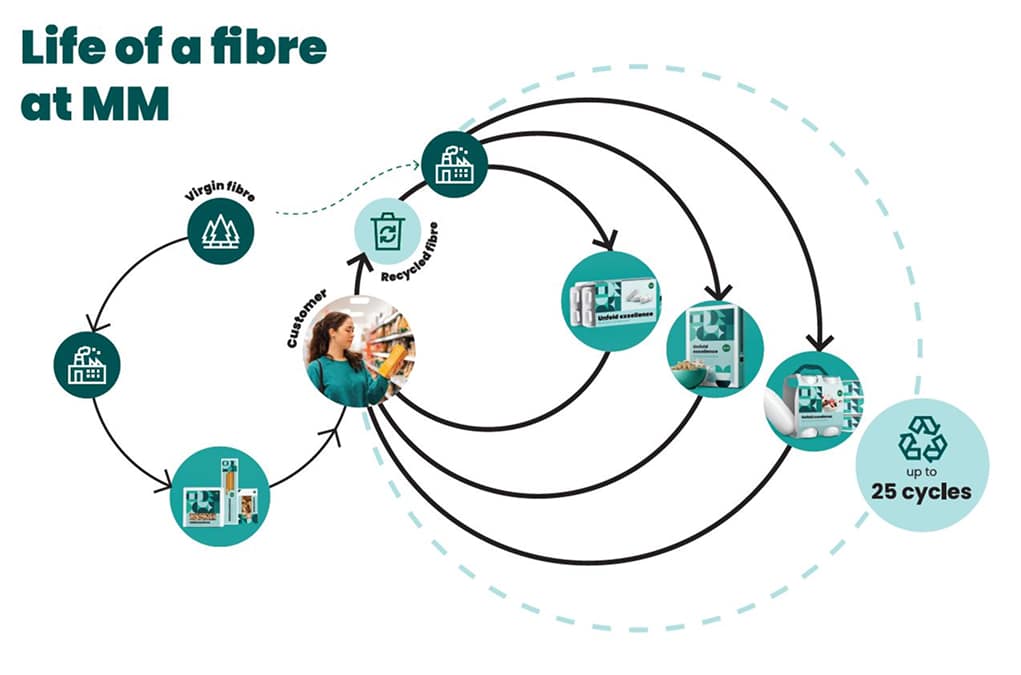
White lined chipboard (WLC) sits within that system. Made from recovered, recycled paper fibres, it is designed to keep material in use rather than drawing on new virgin fibre with every production run. Fibre is collected, sorted, reprocessed, and returned to the system as new cartonboard, extending the value of the material and reducing dependence on virgin input.
Breaking the circularity ceiling
For years, accepted wisdom held that paper fibre could only be recycled around seven times before it became unusable. That figure came from an older experiment that lost so much material at each stage that it simply could not continue past seven loops. The study ran out of material to test and did not demonstrate that the fibres themselves had reached the end of their useful life. The two things were conflated, and the seven-cycle figure stuck.
A later study by MM Board & Paper and TU Graz set out to test that assumption properly. Running for approximately one year, the research team used improved sheet-forming methods that reduced experimental losses to roughly 1% per cycle — far lower than earlier trials. This allowed the same fibre to be pushed through more than 25 laboratory recycling cycles, with the relevant strength and drainage properties remaining stable throughout. The study focused specifically on folding cartons, making it the most directly relevant research for WLC and cartonboard more broadly.
Separate research from TU Darmstadt reached a similar conclusion using a different methodology, adding broader support to the idea that recycled fibre can withstand repeated use rather than degrading on a fixed schedule. TU Graz remains the primary reference here because it examined folding carton fibre specifically, but the Darmstadt findings reinforce that this is not a one-off result.
Recycled is not downcycling
Recycled fibre in packaging is sometimes treated as an automatic step down, as though each cycle produces a slightly lower-value material until it is no longer usable. However, the research does not support that view. Repeated recycling does not, on its own, reduce fibre to something unusable or progressively lower-grade. Under suitable collection, sorting and processing conditions, recovered fibre can remain suitable for high-quality paper and board products across many recycling cycles.
Nevertheless, repeated recycling can influence certain structural properties, such as fibre flexibility and board density. This is why virgin fibres, for example a share of mechanical pulp in the filler ply, can be relevant in maintaining board caliper and bending stiffness – properties that are essential for packaging designed to protect goods during transport.
Where the loop actually loses material
None of this means fibre circulates indefinitely in practice. Material is lost at each real-world stage –
collection, sorting, cleaning, and processing – in ways a controlled laboratory test does not fully replicate. More than 25 cycles is a laboratory result under improved conditions, not the average number of cycles achieved by every tonne of fibre on the market. Virgin fibre remains necessary to replenish these losses and keep the overall system topped up. The value of the research is not that fibre never needs replenishing — it is that the fibre itself is not the limiting factor. Collection and processing infrastructure are.
What this means for specification
Specifying WLC creates demand for recovered fibre, which gives collection and processing systems a reason to keep functioning and improving. Recyclability alone does not close the loop – a material can be technically recyclable and still end up landfilled or exported if nothing pulls it back into production. Recovered fibre has to actually be used in new products for the loop to mean anything, and this is the demand side WLC specification supports.
FAQs
It means the material is intended to stay in use through collection, recycling, and reprocessing, rather than being treated as a one-time packaging resource.
Because it is made from recovered paper fibres and designed to re-enter the fibre loop after use.
Paper fibres can be recycled over 25 times in laboratory conditions without losing strength properties. Research by MM Board & Paper and TU Graz shows that fibres maintain their integrity through multiple cycles, providing strong environmental credentials and supporting circular economy goals. The exact number of cycles in the market depend on maturity of recycling systems and various external factors. Recycled cartonboard prevents downcycling of fibres.
Recycled fibres offer strong environmental credentials and support circular economy goals by keeping valuable materials in use for longer. For brands, this provides a credible basis for communicating the circular benefits of their packaging to consumers, retailers and regulators.
Yes. It influences consumer trust, helps support sustainability targets, and strengthens the case for fibre-based packaging in markets where recyclability matters more than ever.