How MM Group Prepares to Respond and Report on Biodiversity, Driving Strategy Forward
Biodiversity reporting at MM Group is more than a disclosure exercise — it is about translating knowledge into action. It begins with understanding how the company interacts with nature and flows into how these insights guide strategic decisions, governance and operational priorities.
This final article in MM’s biodiversity series focuses on the Prepare phase of the Taskforce on Nature-related Financial Disclosures (TNFD) LEAP framework (LEAP stands for Locate, Evaluate, Assess and Prepare). Following the earlier steps — Locate, Evaluate and Assess — Prepare is where the company turns insight into practical action, embedding biodiversity considerations into strategy and ensuring transparent reporting across operations and supply chains.
Biodiversity Analysis and Reporting as a Continuous Journey
The TNFD LEAP framework is a learning journey that helps organisations progressively deepen their understanding of their relationship with nature.
In the Locate phase, MM Group mapped where its operations and supply chains intersect with ecosystems across mills, sourcing regions and landscapes. This spatial perspective created the foundation for understanding potential biodiversity pressures and dependencies.
The Evaluate phase then explored how business activities rely on ecosystem services and how they may affect biodiversity. This step addressed fundamental questions such as why biodiversity is important to business resilience, resource availability and long-term value creation.
In the Assess phase, these insights were prioritised. Nature-related risks and opportunities were examined through the lens of materiality, scenarios and the significance of impacts and dependencies.
The Prepare phase builds on all this work. It brings clarity to what these insights mean for how a company plans, governs and communicates its response through biodiversity reporting.
Integrating Biodiversity into Business Thinking
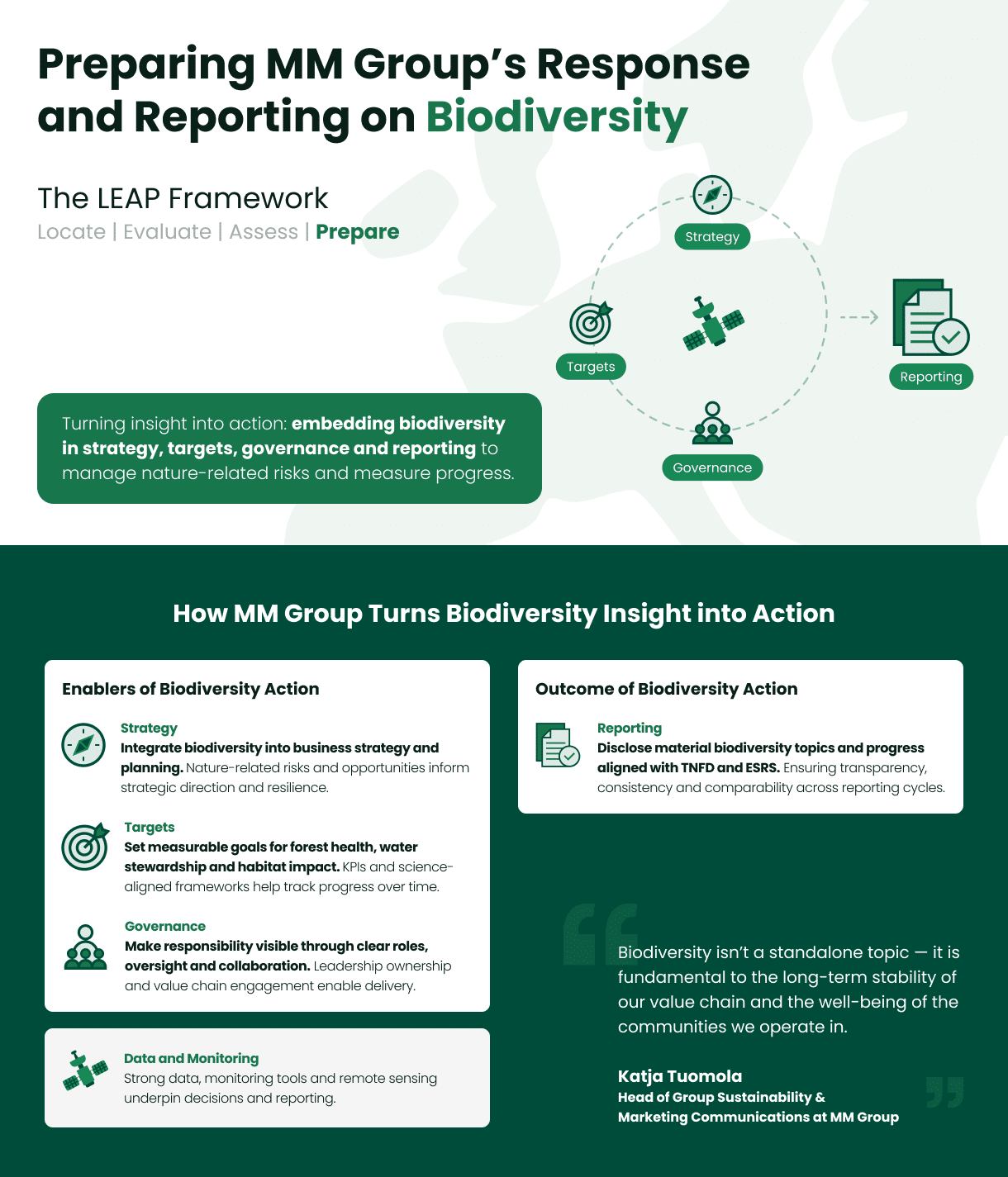
One of the central outcomes of the Prepare phase is the integration of biodiversity into strategic thinking. Based on insights from the Assess phase, companies consider how nature-related risks and opportunities influence their long-term direction.
This may include reflecting on questions such as:
- How can access to key raw materials be secured in a changing ecological context?
- How might ecosystem degradation or regulatory change affect operations and supply chains?
- Where do opportunities exist to strengthen resilience through biodiversity conservation?
By addressing these questions, companies reinforce the importance of biodiversity as a core business consideration — closely linked to continuity, innovation and trust.
Defining Progress on Biodiversity through Targets
Understanding biodiversity challenges is only meaningful if it leads to measurable progress. In the Prepare phase, companies begin to clarify what “good” looks like by setting targets that reflect their strategic ambitions.
To operationalise strategy, companies establish targets, such as
- Physical risks: arising from ecosystem degradation, such as declining forest health, water scarcity or biodiversity loss affecting fibre availability.
- KPIs that allow progress tracking and comparison over time.
- Science‑based alignment with global biodiversity frameworks.

These targets help translate high-level intent into practical direction. They provide a reference point for decision-making, enable progress to be tracked over time and strengthen the credibility of biodiversity reporting.
Rather than focusing on technical detail, the emphasis remains on clarity: targets help organisations understand whether they are moving in the right direction.
Making Responsibility Visible and Aligned with Biodiversity Goals
Another important aspect of the Prepare phase is ensuring that responsibilities and resources are aligned with biodiversity commitments. This is where governance structures, internal ownership and collaboration come into focus.
Effective biodiversity reporting depends on:
- Clear roles at both leadership and operational levels.
- Strong and reliable data (e.g., remote sensing, monitoring tools, etc.)
- Cooperation across value chains, including engagement with suppliers, local stakeholders and external expertise, such as a biodiversity consultant.
This step makes biodiversity management tangible. It shows how insights are translated into everyday decision-making across the organisation.

Preparing for Transparent Biodiversity Reporting
As expectations around nature-related disclosure continue to evolve, the Prepare phase also supports readiness for reporting. This includes alignment with the TNFD framework, its recommendations and emerging requirements such as CSRD (Corporate Sustainability Reporting Directive) and ESRS (European Sustainability Reporting Standards).
For biodiversity reporting, this means:
- Clarifying which topics are material and should be disclosed.
- Embedding reporting into existing governance and annual cycles.
- Ensuring transparency, consistency and comparability over time.
For TNFD early adopters such as MM Group, this preparation supports credible biodiversity reports that are useful not only for compliance, but also for planning and strategic reflection.

What the Prepare Phase Means for MM Group
For MM Group, the Prepare phase represents a natural continuation of the work already undertaken. Building on insights from the Assess phase, the company uses these findings to inform strategic planning and shape nature-related goals aligned with its broader sustainability ambitions. At the same time, monitoring frameworks across mills and supply chains are strengthened, ensuring that biodiversity considerations are embedded throughout operations. This approach also ensures readiness for transparent and consistent reporting, reflecting both the company’s performance and its commitment to responsible management of natural resources.
This perspective highlights a broader understanding: biodiversity is central to sustaining MM’s value chain and supporting the communities connected to it, while enabling the company to act with confidence in a changing natural environment.
In conclusion, the Prepare phase turns insights into strategy, governance, targets and reporting. It ensures the company is equipped to respond to nature-related risks and opportunities in a structured, forward-looking way.
Taken together, the LEAP journey — from understanding where the company interacts with nature, to evaluating dependencies and impacts and assessing risks and opportunities — shows how MM translates knowledge into action.