Why the circular economy depends on what you specify

When you specify recycled cartonboard, you are actually making two decisions: a material choice and an infrastructural one. Most businesses primarily think about the first. But the second plays a decisive role in determining whether the circular fibre economy remains viable.
The established system for producing recycled cartonboard cannot sustain itself in isolation. Collection, sorting, processing – all of it depends on the existence of a commercial market for its output. When demand falters, the economics holding the chain together begin to weaken.
White lined chipboard (WLC) connects recovered paper to new packaging applications, keeping valuable material in use for at least 25 lifecycles. For this material, the business case and the circularity case are ultimately the same. It is a connection I have spent my career working with and advocating for.
Managing a changing raw material
Recovered paper is not a stable input. At MM Board & Paper, this is part of our daily reality. At our Frohnleiten mill we process around 20 different recovered paper grades, and the mix we work with changes as material collection patterns evolve.
One of the most significant shifts in recent years has been the decline in graphic paper volumes, which historically made up a larger share of recovered fibre streams. The material we process today behaves differently from the material we worked with even five years ago. That is not a problem in itself, but it does mean that producing high-performing recycled cartonboard requires constant adaptation, technical expertise and process discipline.
At the same time, customer expectations remain unchanged. Brands and converters need recycled cartonboard that meets specification reliably, runs consistently in processing and performs as expected in the final application. Delivering that consistency while the raw material base continues to change is one of the core technological challenges in recycled board production.
This is where deep fibre knowledge becomes essential. Understanding the characteristics, limitations and potential of different recovered fibre streams is what allows us to adapt processes continuously and maintain material performance at a high level.
Stock preparation
One of the most important contributors to WLC quality is stock preparation. It is also one of the most underestimated. I sometimes compare it to the work of Cinderella: the task is to separate out everything that does not belong, while recovering as many usable fibres as possible from what arrives. It may not sound glamorous, but like Cinderella, what emerges from that process, when it is carried out with care and precision, is something transformed.
During stock preparation, recovered paper is mixed with water in pulpers and processed through a series of cleaning and separation stages. Fibres are released from the paper structure, while unwanted materials and contaminants are removed using different technologies. The objective is clear: maximise the yield of usable fibre while ensuring that impurities are excluded from the process stream as effectively as possible.
This stage has a direct impact on the cleanliness, consistency and quality of the final board. It is also fundamental to maintaining the hygiene standards required for sensitive applications. Achieving that level of performance depends on precise process control, continuous monitoring and a strong understanding of how fibres behave under changing input conditions.
For me, this is one of the most fascinating parts of the entire process. This is where technical expertise has the greatest impact.
Consistency on press
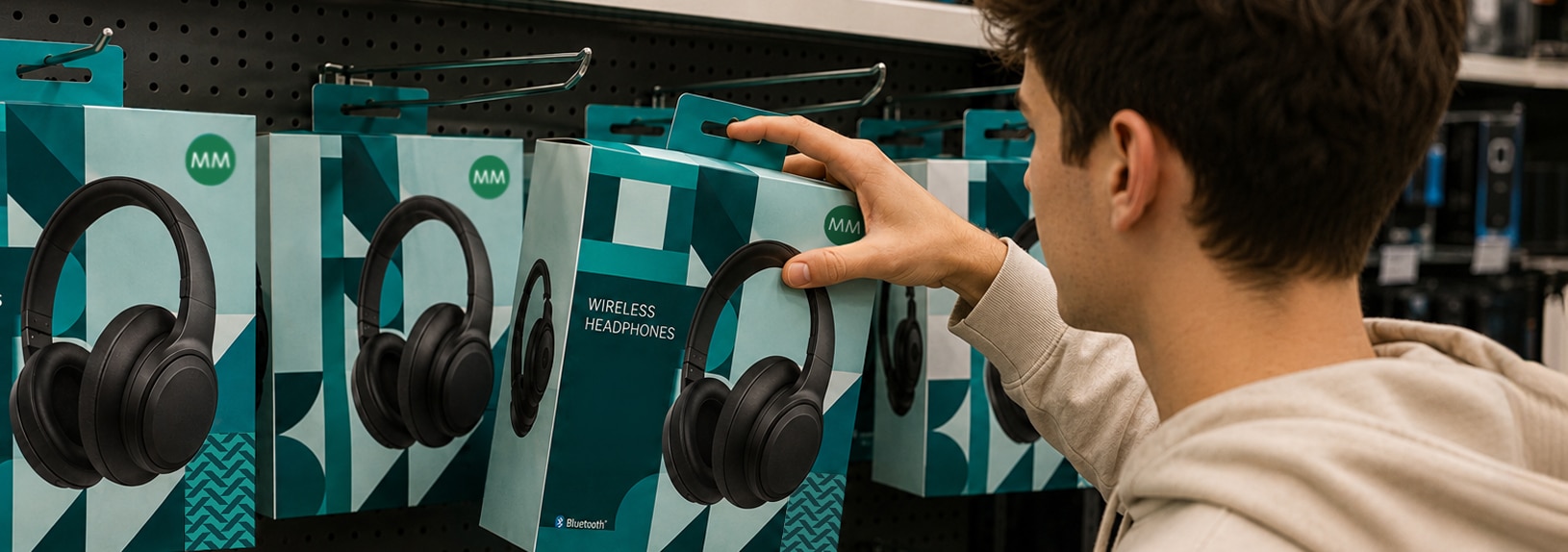
For converters, one requirement stands above all others: the board must run consistently. Predictable behaviour on printing press, stable caliper and reliable converting performance are not optional. They are essential.
At MM Board & Paper, our focus is on delivering WLC that performs consistently in real converting environments. That means controlling variation as tightly as possible throughout production and understanding in detail how different fibre inputs affect the final material.
But the reason this matters goes beyond any individual converting run. WLC only works as a circular material so long as it keeps being chosen. Every time it performs well on a converting line and ends up in a product that is collected and recovered, another cycle of the loop can be completed.
Across Europe, 87% of paper and board is already collected and recycled. The infrastructure exists. The fibre is there. Whether this system continues to function at scale depends on the choices being made in specifications today.
Closing the loop
I have worked with recycled board for many years, and that experience has only strengthened my conviction in its value. Fiber is too valuable to be used once and discarded. The infrastructure to recover it and put it back to work already exists. What matters now is making sure the material continues to be specified, trusted and used.
Specifying WLC is not only a material decision. It is an active contribution to the system that makes circular packaging possible. And that system depends on confidence – confidence that recycled cartonboard can meet performance expectations, support efficient converting and deliver consistent results.
That is why technology matters. And that is why specification matters.